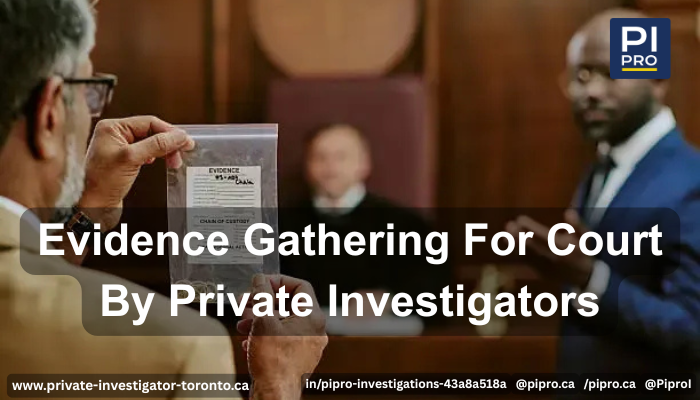
Evidence Gathering for Court by Private Investigators
In case of any form of legal action, good and solid evidence may be the difference between winning and losing. This is where the need to collect evidence in court arises. There are various individuals and businesses that turn to professional private investigators to gather the admissible evidence that may stand before a judge. Having a civil conflict, a family law case, a claim of fraud, or a misconduct in the workplace, the correct evidence collection will help you to get the legal evidence necessary to safeguard your rights.
This guide separates evidence collection in the court into what it is actually all about, how the work of a private investigator court support can work, and what you ought to be aware of prior to commencing the legal investigation.
What Is Evidence Gathering to Court?
Court evidence collection is the process of accumulating information, and documents, testimony and surveillance containers that are legally accepted and may be brought up in court. It is aimed at ensuring the admissible evidence, i.e. the information that should be accepted by the court, and is legally admissible.
In contrast to overall fact-finding or personal investigations of a case, there are stringent rules to be adhered to in evidence collection to be presented in court. That is why a lot of clients use the help of trained investigators who have knowledge of the privacy regulations, documentation forms, and legal aspects.
Why It Matters
- Courts demand clear and original as well as proven legal evidence.
- The evidence should be gathered in a legal and ethical manner to prevent disqualification.
- Evidence that has been poorly documented may be disallowed, undermining your whole case.
- Professional investigators are aware of how they can collect information without crossing the legal lines.
Categories of evidence investigations
There are numerous techniques in gathering evidence that is presented in court by private investigators. All forms of evidence have their own purpose with regards to the nature of a case.
-
Surveillance Evidence
Surveillance is usually applied in situations where it relates to:
- Insurance fraud
- Workplace misconduct
- Domestic disputes
- Co-habitation verification
- Child safety concerns
-
Digital and Online Evidence
This is because with all the activity occurring on the internet, digital information has become an important component of legal investigations which include:
- Social media evidence
- Email or message analysis
- Online activity tracking
- Digital footprint mapping
- Background investigations
Such evidence should be taken responsibly so as it can be accepted in a court of law.
-
Witness Statements
The statements that are obtained by the private investigators are usually formal statements by persons who possess the relevant knowledge about an event. A well documented statement of witnesses is useful in a court case since it gives first hand narrations, which substantiate the reasons.
-
Money and Paper Evidence
This includes:
- Bank statements
- Business records
- Transaction logs
- Documents on ownership of property.
- Employment records
They are fundamental in civil litigations, fraud and claims involving finances.
-
Background and Due Diligence Evidence
Background checks give important information on the character, history of a person and behaviour in case of custody, employment, fraud or civil claims.
How the Private Investigators Carry out the Evidence Gathering before the court?
Professional investigators adhere to the rigid protocols so that all information is not obtained illegally and handled in an appropriate way.
-
Primary Consultation and Case Evaluation
The investigator talks about your case, and he will outline your objectives and arrive at the kind of evidence needed. This step is used to make sure that your goals are within the confines of the law.
-
Planning the Investigation
The strategy developed by the investigator can involve:
- Surveillance planning
- Witness interviews
- Background checks
- Document retrieval
- Digital research
Each course of action is tailored to a case of law.
-
Implementation of the Investigation
The investigator in this stage will execute the strategy without violating any of the privacy and legal standards. This makes the material still admissible evidence.
-
Recording and Maintaining Evidence
Company documentation should contain:
- Clear written reports
- Videos and photos have a time stamp.
- Protective management of online records.
- Chain-of-custody logs
Evidence that is well kept and professionally documented is more believable in courts.
Offering Court Support in the role of a Private Investigator
The private investigators can also:
- Prepare court-ready reports
- Help lawyers with evidence inspection.
- Provide sworn testimony
- Provide the court with explanations of investigation findings.
This court support by a private investigator assists in making the case stronger and also makes the judge have a clear picture regarding the evidence.
What is Admissible in Court?
Not every evidence can be admitted to court. The evidence should comply with legal standards in order to be admissible.
The major conditions of admissible evidence:
-
Legally Obtained
The evidence should be obtained without breaking any privacy regulations or trespassing.
-
Relevant to the Case
The details should relate to a statement, charge or defence.
-
Accurately Documented
Evidence of low quality or evidence not confirmed can be dismissed.
-
Credibility and Authenticity
Verifiable evidence that the evidence is real is required by the courts.
-
Clear Chain of Custody
Any oversight in the processing would result into the evidence being excluded.
A private investigator who is experienced in compiling evidence in court is aware of these requirements and will make sure that your materials are up to the legal requirements.
Typical Case Laws in evidence gathering
Something that the private investigators assist in:
-
Family Law Cases
- Divorce proceedings
- Child custody disputes
- Checking alimony or child support.
- Lifestyle and co-habitation research.
-
Civil Litigation
- Breach of contract
- Property disputes
- Personal injury claims
- Business disagreements
-
Financial Misconduct and Fraud
- Employee theft
- Insurance fraud
- Financial deception
- Identity misuse
-
Employment and Workplace Problems
- Misconduct
- Harassment
- Wrongful dismissal claims
- Safety violations
Both categories of cases need various legal evidence and methods of investigation.
Benefit of engaging a licensed private investigator
By recruiting a certified expert, the evidence collection to court is carried out in a proper way throughout the whole process.
Key Advantages:
- Local and federal legal knowledge.
- Knowledge on presenting court investigations.
- Publicly unavailable database and resource access.
- Professionalism and objectivity.
Capability to offer court support of private investigators where necessary.
Conclusion
Good cases in the court are those that have strong evidence which has been acquired through legal means. Be it a family case, work problem, civil dispute and fraud case, evidence collection in court gives the required evidence and legal demonstration that is admissible to the court. Through a professionally trained investigator, you will be able to enter the court proceedings without any fear of being embarrassed because your case has been fully supported with proven and professionally recorded information.
In case you require reliable court investigations of the law or professional PI court investigations, our staff is willing to help you with all the procedures.
FAQs about Evidence gathering
- What is evidence gathering to the court?
Gathering evidence before court involves compiling papers, surveillance videos, eyewitness testimonies, electronic files among other evidence that has been acquired legally and can support a case.
- Is a private investigator capable of gathering admissible evidence?
Yes. A licensed investigator will be trained to collect admissible evidence that satisfies the court standard and all legal requirements.
- What is the benefit of using private investigator court support?
In court assist services, one option is to hire a private investigator to help in the investigation of your case through reports preparation and documenting evidence, as well as testifying in your favor.
- Does a private investigator gather evidence that is deemed legal evidence?
The majority of the evidence can be accepted provided that it is obtained legally, is properly documented, and is complied with the chain-of-custody regulations. This will make it legal evidence in a court.