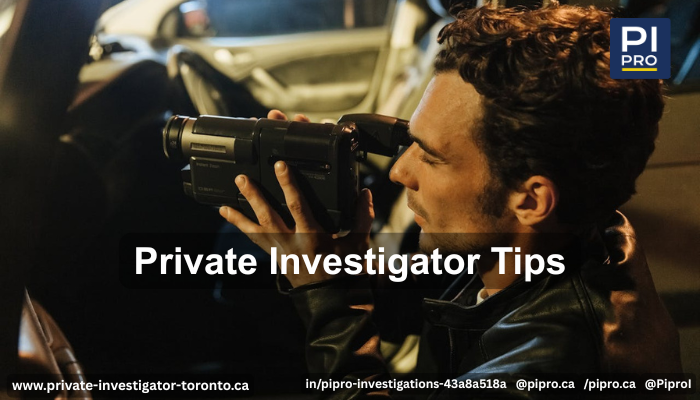
If you are searching for practical private investigator tips in Ontario, start with what actually helps a licensed investigator deliver usable evidence. Hiring alone is not enough. How you prepare, what you share, and what you avoid can decide whether the file is clear, lawful, and useful for counsel or your own decisions.
PiPro is a licensed private investigation agency serving Toronto and the GTA. These tips focus on the client side of an investigation: preparation, cooperation, legal boundaries under Ontario rules, and how to read a report without overreaching. For a separate checklist on choosing an investigator, see our guide on hiring a private investigator in Ontario legally.
Tip 1: Clarify the question you need answered
Investigators work best from a defined question, not a vague feeling. Write one sentence that states the goal. Examples: “Document whether my spouse meets this person after work,” “Confirm whether an employee removes stock after closing,” or “Locate a last known address for service.”
A clear question helps us choose lawful methods, estimate hours, and avoid scope creep. If family law counsel is involved, ask them what evidence format they prefer before field work begins.
Tip 2: Gather what you already know (and leave the rest)
Useful starting points often include names, dates of birth if known, vehicle descriptions, workplaces, usual routes, phone numbers you already have lawfully, and a timeline of recent events. Screenshots of messages you are entitled to access can help. Do not hack accounts, guess passwords, or install spyware. That can taint evidence and create legal risk for you.
Bring a short written chronology. Investigators spend less time reconstructing history and more time documenting what matters now.
Tip 3: Do not tip off the subject
Confronting a suspected cheating spouse, warning a co-worker under review, or posting about the case on social media can collapse surveillance opportunities. Once a subject knows they are being watched, patterns change and hours increase.
Share the matter only with people who need to know, such as your lawyer. Keep conversations off shared devices when possible.
Tip 4: Stay inside Ontario’s legal lines
Licensed private investigators in Ontario operate under the Private Security and Investigative Services Act, 2005 (PSISA), administered through the Ministry of the Solicitor General. Lawful work can include discreet surveillance in public places, open-source research, skip tracing, and documented interviews where appropriate. It does not include illegal phone taps, unauthorized access to private emails, or trespass.
Ask your investigator to explain methods in plain language. If someone promises “guaranteed” proof of guilt or access to phone records without consent, treat that as a warning sign, not a sales pitch.
Tip 5: Match the tip to the case type
Different matters need different preparation.
- Infidelity or family concerns: Note patterns, not theories. Share relevant addresses and vehicles. Avoid following the subject yourself. See our cheating spouse investigation service for how discreet surveillance is typically scoped.
- Corporate or workplace issues: Define policy breaches, loss events, and who has access. Align with HR and counsel early. Our corporate investigation work focuses on lawful fact-finding and documentation suitable for internal review.
- Background or identity questions: Provide consent forms where required and exact identity details. Online DIY checks are often incomplete; a structured investigative research process is clearer for hiring or partnership decisions.
- Skip tracing / missing persons: List last confirmed contacts, cities, employers, and any prior addresses. Be realistic about timelines when leads are thin.
Tip 6: Plan for Toronto and GTA logistics
Local movement patterns affect surveillance. Dense areas along Yonge, Bloor, and the downtown PATH, condo lobbies, parking structures, and 401 corridor travel all create different cover and timing needs. Retail plazas in Scarborough or Mississauga, shift work in industrial parks, and transit-heavy routes can require more than one observer or staggered shifts.
Tell your investigator about parking constraints, security desks, and typical schedules. That detail saves billable hours.
Tip 7: Agree on scope, updates, and budget in writing
Before work starts, confirm what is included: hours, geographic limits, report format, and whether video stills or written logs are the deliverable. Ask how often you will receive updates. Unexpected travel, overnight coverage, or multi-subject files cost more; a written estimate reduces surprises.
Confidentiality should be explicit. A professional agency treats your matter as discreet by default.
Tip 8: Know how to use the final report
A useful report usually includes dates, times, locations, observations, and supporting photos or video where lawful and relevant. It should describe what was seen, not invent motives. If you need the file for family law or civil counsel, ask whether the format and chain of custody notes meet their needs.
Do not edit raw evidence yourself or post clips online. Altering materials can weaken credibility.
Common mistakes that waste time and money
- Hiring before you define the question you need answered.
- Running your own surveillance and contaminating the scene.
- Sharing the investigation with friends or on social media.
- Expecting illegal methods or guaranteed courtroom wins.
- Skipping a written scope and then disputing hours later.
How PiPro typically works with clients
- Confidential consult: You explain the problem, goals, and constraints.
- Scope and estimate: We outline lawful methods, likely hours, and reporting format.
- Field and research work: Investigators document observations and leads.
- Report delivery: You receive a clear summary you can act on with counsel or internally.
We keep communication practical and discreet. If the facts do not support the outcome you hoped for, we say so plainly.
Private investigator tips: FAQs
What are the most important private investigator tips for first-time clients?
Define a clear question, share a factual timeline, avoid tipping off the subject, stay within lawful methods, and get scope and fees in writing before work begins.
Can I put a tracker on my spouse’s car in Ontario?
Do not assume GPS tracking is automatically lawful. Consent, ownership, and use of the vehicle all matter. Discuss options with a licensed investigator and, where relevant, your lawyer before installing anything.
How much information should I give my investigator?
Share verified facts, schedules, vehicles, and documents you lawfully possess. Skip rumours and illegal account access. Quality of intake usually improves quality of results.
How long does surveillance usually take?
It depends on the subject’s routine and the question you need answered. Some files resolve in a few targeted shifts; others need repeated coverage. Your estimate should explain that range up front.
Will a private investigator guarantee results?
No ethical investigator can guarantee a specific finding. We can guarantee lawful process, clear reporting, and honest communication about what the evidence shows.
Should I tell my lawyer before hiring a PI?
If the matter may go to court or negotiations, speaking with counsel first often helps. They can advise on evidence needs and privilege issues for your situation.
Next step
If you want discreet help applying these private investigator tips to a real file in Toronto or the GTA, contact PiPro for a confidential consultation. Call 416-912-7755 or reach us through our contact form. We will listen first, then tell you what is realistic and lawful.